AI Is Moving from Prompts to Agents — and Most IDEs Are Still Playing Catch-Up
Posted at 8-January-2026 / Written by Rohit Bhatt
30-sec summary
The landscape of AI coding tools is shifting from stateless chat prompts to context-aware agents. This article explores the 'Goldfish Memory' problem, compares leading tools like Cursor and Windsurf against traditional IDEs, and discusses the rise of 'Vibe Coding'.
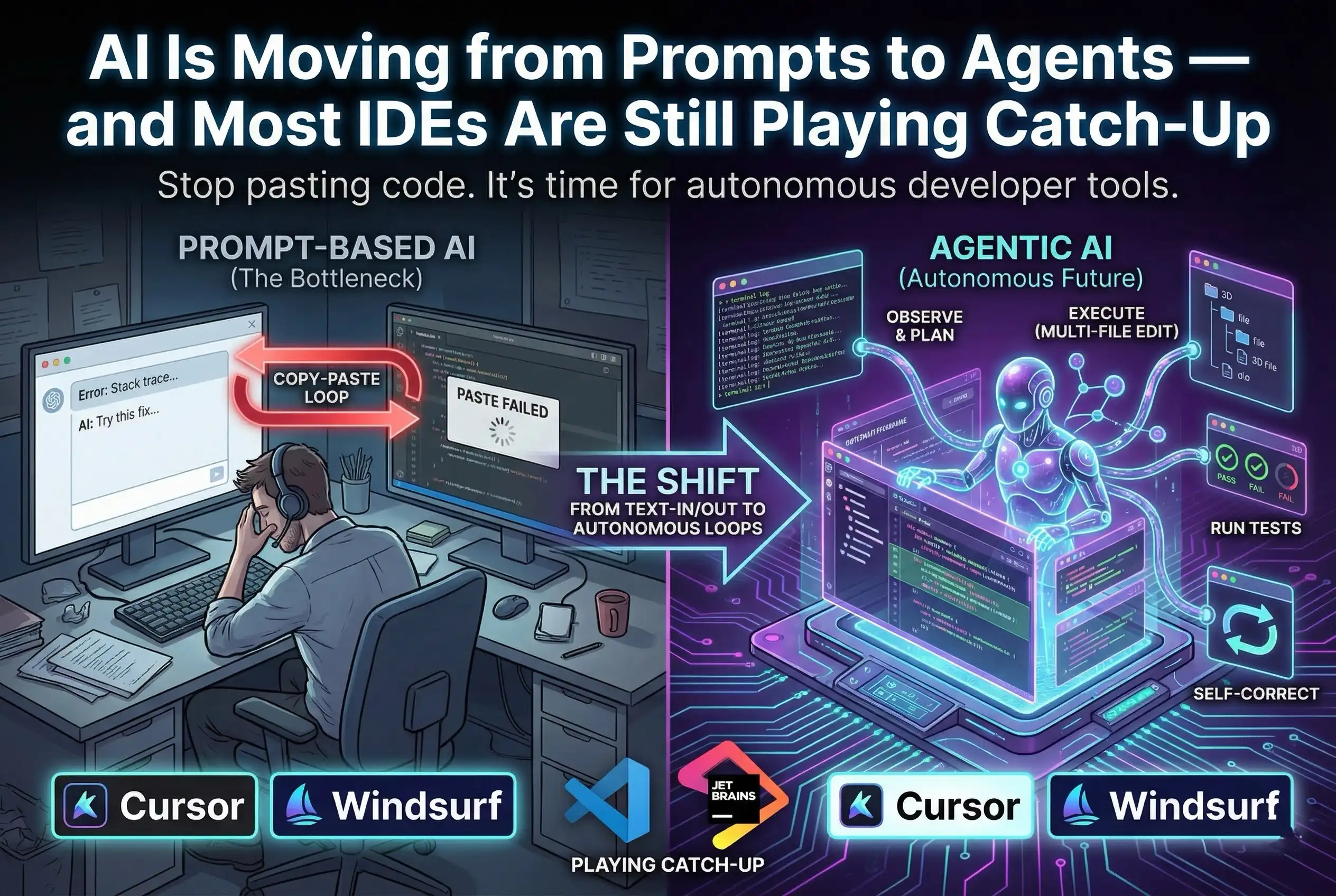
It’s 1:00 AM. You’re staring at a stack trace that makes no sense. You copy the error, tab over to ChatGPT, paste it, and wait. It suggests a fix. You copy the code, tab back to VS Code, paste it, and run the build.
It fails again.
You tab back to the browser. "That didn't work," you type, pasting the new error.
If this loop feels familiar, you’re experiencing the bottleneck of Prompt-Based AI. For the last two years, we’ve effectively been acting as copy-paste middleware between LLMs and our codebases [1]. We manage the context, we apply the diffs, and we run the terminal commands. We are the runtime environment for the AI.
But 2025 has marked a hard shift. We are moving from Prompts (text-in, text-out) to Agents (autonomous loops that can read, plan, execute, and fix) [3]. And honestly? Most of the tools we use today are architecturally unprepared for it.
Here’s what is actually changing, who is winning the race, and why you might want to stop pasting code into a sidebar.
The “Goldfish Memory” Problem
The fundamental issue with the standard "Chat Sidebar" (whether it's Copilot or ChatGPT) is that it’s stateless. It doesn't really know your project. It doesn't know that changing UserContext in one file breaks a migration file three folders away—unless you manually copy both files into the chat [5].
This leads to what I call the Context Gap. You spend half your time acting as a "Context Manager," trying to feed the right snippets to the model so it doesn't hallucinate [1].
Agents change the topology. An agent doesn't just wait for you to type. It enters a loop: Observe → Orient → Decide → Act → Self-Correct [4].
Imagine chasing a flaky test.
- 1.Prompt approach: You paste the test failure. AI suggests a fix. You try it. It fails. You paste the new error.
- 2.Agent approach: You tell the agent "Fix this flaky test." The agent runs the test, sees it fail, reads the logs, modifies the code, runs the test again, sees it fail differently, modifies it again, and only pings you when the test passes [4].
To make this work, the AI needs deep access to your file system, terminal, and build tools. And this is where legacy IDEs are hitting a wall.
The Landscape: Who is Leading, Who is Lagging?
The market has split into three distinct categories based on how they handle this new agentic reality.
1. The Leading Edge: AI-Native Editors (Cursor & Windsurf)
These tools realized that you can't just slap an AI plugin onto VS Code and call it a day. They actually forked VS Code to rewrite the internals, treating the AI as a first-class user [6].
- 1.Cursor: This is currently the heavyweight champion of "Vibe Coding" (more on that later). Its killer feature is Composer. You don't edit a file; you edit a feature. You can say "Refactor the auth flow to use Supabase," and it calculates the edits across your API routes, database schema, and frontend components simultaneously [13]. It uses a "Shadow Workspace" to lint and check code before it even hits your screen, reducing the number of syntax errors you have to look at [13]. One developer reported doing a 12,000-line refactor in 3 hours using this workflow—something that usually takes months [17].
- 2.Windsurf: While Cursor focuses on raw power, Windsurf focuses on Flow. Its agent, Cascade, has a deep temporal memory—it knows what you just did. If you run a command and it fails, Cascade sees the terminal output and proactively offers a fix [21]. It also uses "Supercomplete" to predict your next action, not just your next word—like offering to run a test after you write it [22].
The Verdict: These tools are winning because they own the pixels. They can seamlessly integrate the AI into the editor's event loop, making multi-file edits feel native rather than jarring [6].
2. The Wild West: Power User Extensions (Cline)
If you don't want to switch editors and have a high tolerance for risk (and cost), there's Cline (formerly Claude Dev).
Cline is an open-source extension that runs on a "Bring Your Own Key" (BYOK) model. It is aggressively autonomous. If you tell it to delete your database and reseed it, it will do it [31]. It can use a headless browser to look up docs and run terminal commands to verify its own work.
The Catch: The "Token Tax." Because Cline sends massive amounts of context back and forth to maintain its loop, it gets expensive fast. We’re talking $20 to $50 a day in API costs for heavy refactoring sessions [32]. It also has a tendency to get stuck in "Infinite Loops," burning cash while trying the same failed fix over and over [33].
Side note: Cline is heavily driving the adoption of MCP (Model Context Protocol), a new standard that acts like a "USB for AI," letting agents plug into databases or tools like Linear without custom code [34].
3. Playing Catch-Up: The Incumbents (VS Code & JetBrains)
The giants are struggling with the Innovator's Dilemma.
- 1.VS Code (Microsoft): They have Copilot Agent Mode, but it’s hobbled by safety. Microsoft’s enterprise customers are terrified of data exfiltration, so Copilot defaults to a "Mother, may I?" workflow. You have to manually approve file edits and terminal commands [26]. It breaks the autonomous loop. If I have to click "Approve" for every file change, I’m just a glorified permission slip [12].
- 2.JetBrains: They are betting on Static Analysis over raw speed. Their agent, Junie, tries to use the IDE’s deep understanding of code structure (PSI) to be more accurate [15]. The problem? It feels sluggish. Indexing takes time. When an agent tries to edit five files at once, the IDE often chokes or freezes, making the experience feel like you're fighting the tool rather than working with it [14, 29].
The New Reality: "Vibe Coding" and Syntax Amnesia
This shift is creating a new style of development called "Vibe Coding." You focus on the business logic and the aesthetic (the "vibe"), and let the agent handle the implementation details [36]. It’s incredibly empowering—backend devs are building beautiful frontends, and frontend devs are writing complex SQL queries.
But it comes with a hangover.
- 1.Reviewer Fatigue: It is much easier for an AI to generate 1,000 lines of code than it is for a human to review it. We are seeing a rise in "Blind Merging," where developers gloss over AI-generated code, missing subtle bugs or security holes [38].
- 2.Syntax Amnesia: I’ll be honest—I forgot how to write a
useEffecthook from scratch the other day. I haven't typed one in six months. The AI always does it [38]. We are trading low-level fluency for high-level orchestration.
What’s Next?
The metaphor of the "Text Editor"—a blinking cursor on a blank page—is dying.
We are moving toward "Mission Control" interfaces. In the near future, you won't be typing code; you’ll be orchestrating a squad of agents. One agent runs tests, another refactors the backend, and a third updates the docs, all in parallel [10].
For now, if you’re still manually copy-pasting code from a browser window into VS Code, you are working harder than you need to. The tools have evolved. It’s time to let the agent drive for a bit—just keep your hands near the brake.
This shift to agents is just the beginning. If you're curious about the broader impact of this technology on our landscape in the coming year, I highly recommend checking out my deep dive on the Agentic Shift.